English
 中文简体

Quick Product Search
Contact us to learn how we can use our expertise to bring you high-quality products.
2026-11-06
Centrifugal fans are the quiet workhorses behind ducts, plenums, and appliance air paths. Air enters the inlet axially, turns roughly 90 degrees inside the housing, and leaves through the outlet. Among the many impeller shapes used for that job, the airfoil centrifugal fan is the one engineers reach for when they want high static efficiency and low noise in clean air.
The difference is not in the housing or the motor mount. It is in the blade. An airfoil impeller borrows its cross-section from an aircraft wing, and that shape changes how air behaves on both sides of the blade. The result is a fan that moves a useful volume of air with less turbulence, less power, and often less sound than a simple flat-blade design.
A typical airfoil blade has a rounded leading edge, a cambered upper surface, and a tapered trailing edge. Air accelerates smoothly over the curve instead of striking a flat plate. Because the flow stays attached longer, the blade produces less separation and less wake. That translates into higher static efficiency and a lower noise signature at the same duty point.
Most airfoil centrifugal fans use backward-inclined blades. This arrangement has a useful side effect: the power curve tends to be non-overloading. As system resistance drops and airflow increases, power demand does not run away. That makes the design easier to apply across variable operating conditions, especially in air handling units, heat recovery ventilators, and ducted ventilation products.
| Impeller type | Blade shape | Typical peak efficiency | Pressure capability | Typical use |
|---|---|---|---|---|
| Forward-curved | Many shallow, forward-leaning blades | Moderate | Low to medium | Compact air handlers, low-pressure clean-air ventilation |
| Backward-curved | Simple curved plates, backward-inclined | High, around 86% | Medium to high | General HVAC and clean-air exhaust |
| Radial | Flat or slightly curved straight blades | Lower, around 82% | High | Dirty, hot, or industrial airstreams |
| Airfoil | Wing-shaped, backward-inclined | Highest, around 90% | Low to medium | Clean air, low-noise HVAC and appliance blowers |
The trade-off is straightforward. Airfoil blades do not like sticky dust, grease, or fibrous debris. A profile that works beautifully in clean air can collect buildup in a kitchen exhaust or a workshop. For those jobs, a radial or backward-curved impeller is usually the safer choice. Use the airfoil design where the airstream is filtered or naturally clean, and where sound and power consumption matter.
Clean-air ventilation is the natural home for this impeller. You will find airfoil centrifugal fans in air handling units, energy recovery ventilators, fan coil units, clean-room recirculation systems, and compact ceiling ventilators. They are also common in air purifiers, where a small centrifugal blower pulls air through a filter and pushes it back into the room. In those products, the fan runs for long hours, so a few percentage points of efficiency and a quieter blade passage make a real difference to the user.
Domestic ventilation is another good match. Bathroom exhaust fans, integrated ceiling ventilators, and ducted fresh-air units need steady pressure and low noise in a small package. A centrifugal impeller with airfoil blades can deliver that without the harsh tonal noise that sometimes comes from simpler blade shapes. The impeller is only part of the story, though. The motor, bearing system, and mounting all shape the final acoustic result.
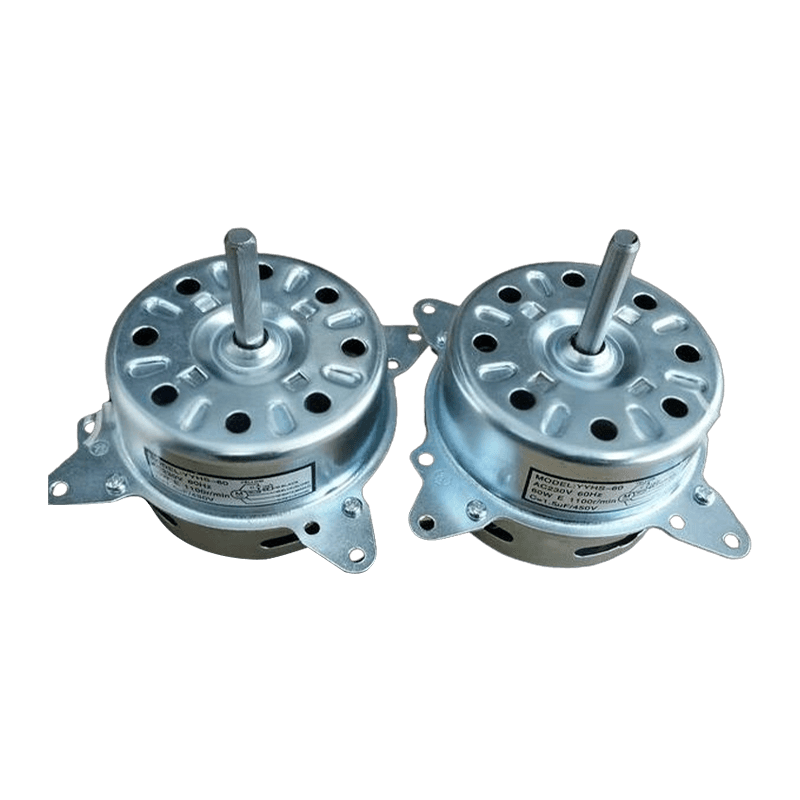
 YYHS-30 Low-Noise Integrated Ceiling Ventilator MotorA bidirectional ball-bearing motor for integrated ceiling ventilators and bathroom exhaust fans, aimed at stable low-noise ventilation in domestic airflow equipment.View Product →
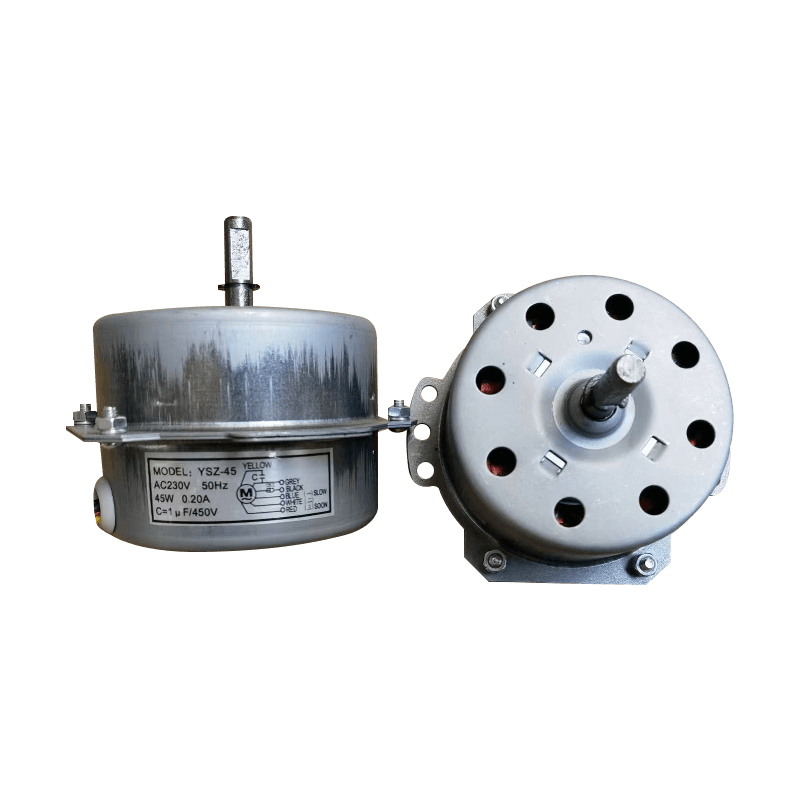
In air purifiers, the fan often runs at several speeds through the day. A motor with stable low-speed behavior and low mechanical noise is valuable, because the user hears the difference at night. The impeller and motor need to be matched as a system, not selected from separate catalogs and assembled at the end.
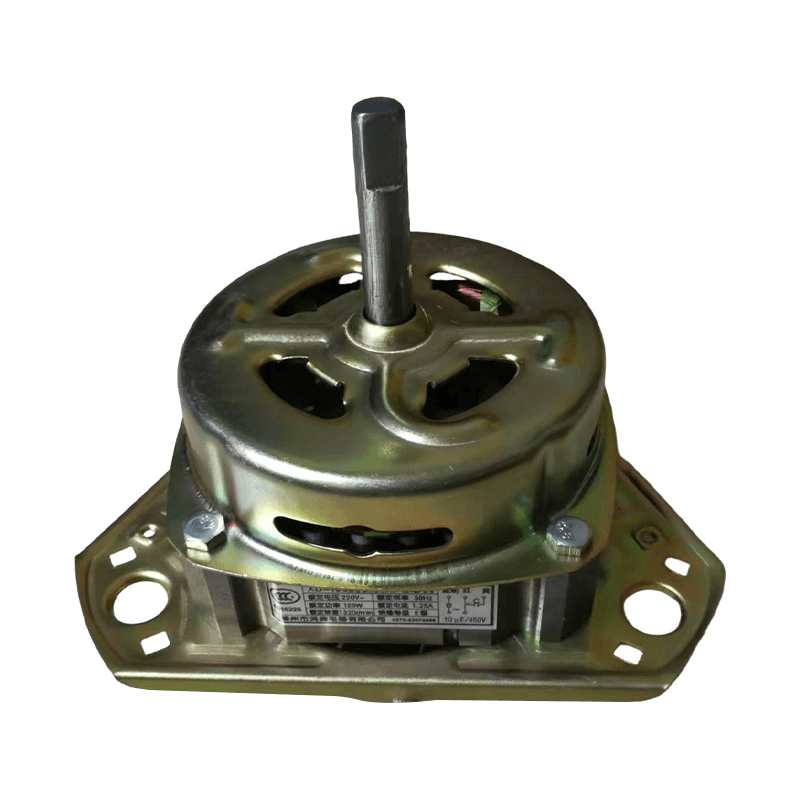
 Air Purifier Motor for Quiet, Stable OperationThis low-noise air purifier motor supports stable, efficient prolonged operation, making it relevant when matching motor behavior to multi-speed fan demands.View Product →
Once the impeller is chosen, the motor sets the operating envelope. Fan laws are a useful starting point: airflow changes in direct proportion to speed, static pressure changes with the square of speed, and shaft power changes with the cube of speed. A motor that is only ten percent faster can demand roughly a third more power. That is why speed taps on a three-speed motor should be designed around the actual impeller and housing, not chosen by habit.
Bearing choice also matters. Ball bearings generally handle higher speeds and longer life, while sleeve bearings can be quieter at low speed but are more sensitive to mounting position. For a ceiling ventilator or an air purifier, the difference is audible. A rigid motor mount and a well-balanced impeller are just as important as the bearing type.
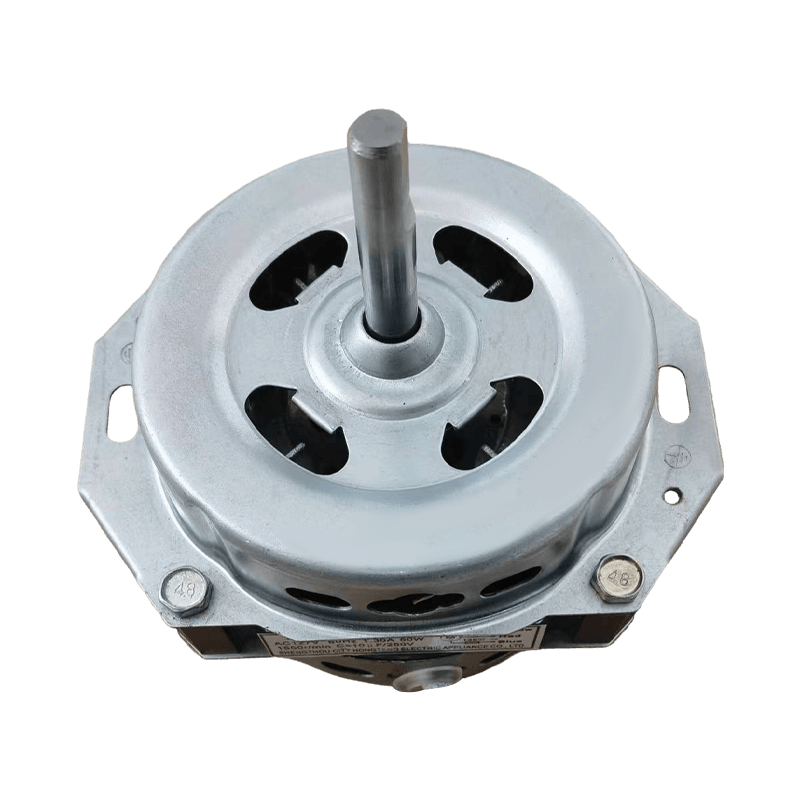
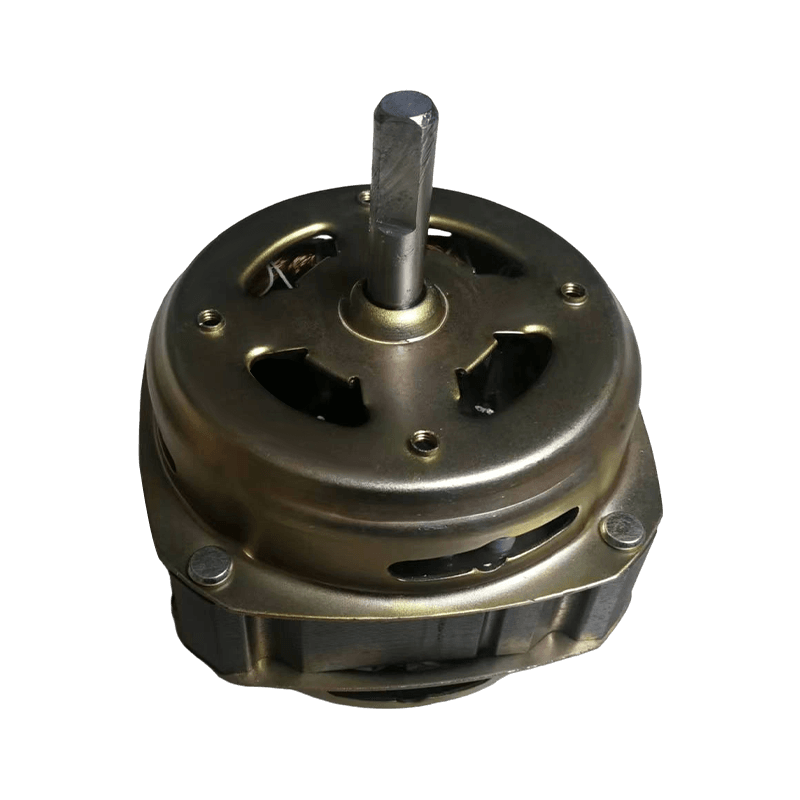
In our own motor workshop, we often see appliance teams focus on the impeller first and the motor last. The better projects bring both to the table early. A three-speed motor with consistent tap performance and controlled vibration can turn an ordinary blower into a product that feels refined.
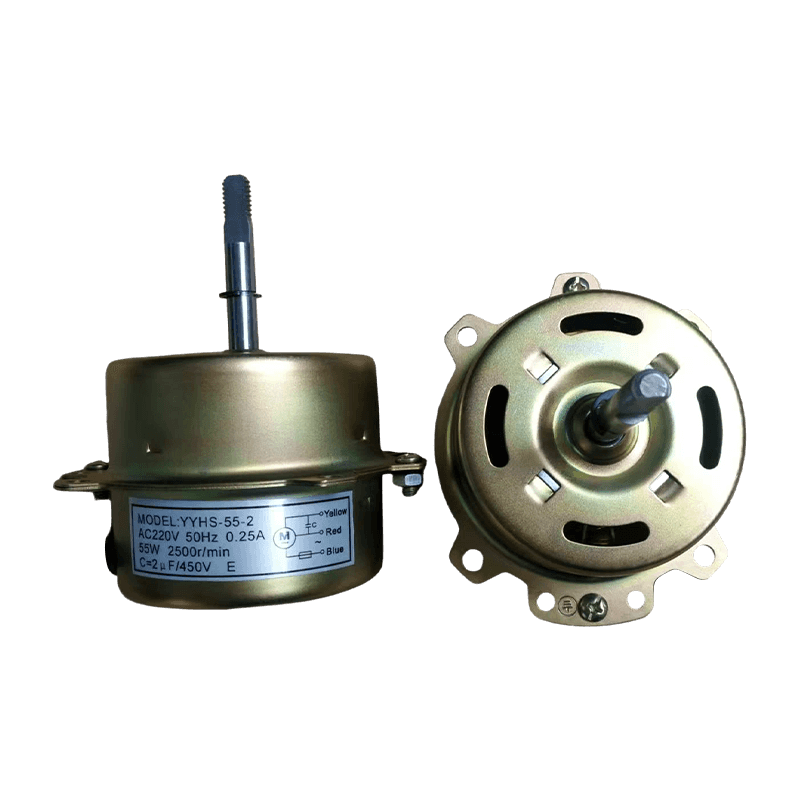
 YYHS-40 Home Ventilation Fan MotorA ball-bearing motor for bathroom and exhaust fans, built for stable low-noise ventilation and continuous operation in humid household airflow systems.View Product →
If you are comparing motor designs for household fans, our guide to floor fan AC motor performance covers similar trade-offs in more detail.
An airfoil blade reduces blade-passage noise, but it cannot fix a poor installation. Inlet turbulence, sharp duct turns, and insufficient clearance around the impeller can all create noise that the blade profile cannot overcome. Tip clearance is especially important. A small, uniform gap between the impeller and the inlet ring helps maintain pressure and reduces the whooshing sound that comes from air leaking backward over the blade tips.
Efficiency is also a system property. A fan that runs at its best point in a laboratory can sit far from that point in a real cabinet with a restrictive filter. When specifying a fan, look at the whole curve, not just the single peak number. The operating point should sit in a stable region, with enough margin for dirty filters and low-line-voltage conditions.
Maintenance is simple in most clean-air products. A soft brush and a vacuum are usually enough. In appliances with long service intervals, the bearing system deserves more attention than the blade. A worn bearing changes the air gap, adds vibration, and can make an otherwise quiet fan sound rough.
Airfoil centrifugal fans are rarely sold as a bare impeller. They arrive inside a product that must work on the local power supply, meet local safety expectations, and sound acceptable in a local home. That means the motor must be available in the right voltage and frequency combinations, with speed taps that behave consistently from one unit to the next. A 60 Hz build will not behave exactly like a 50 Hz build, especially at the low end of the speed range.
Ask for the operating point at both the nominal voltage and the low-voltage condition. Check the temperature rise at the lowest speed, where cooling is weakest. Confirm the insulation system, lead length, and connector type early, because those details often decide whether a pilot build runs on schedule. Our ventilation fan motor range includes regional voltage and frequency variants, and the same platform can often be adapted for a new impeller or housing without starting from a blank sheet.
Airfoil centrifugal fans are efficient because the blade manages air gently. That advantage only reaches the product when the motor, bearing, mount, and housing support the same goal. Start with the airstream: clean air and low-to-medium pressure favor an airfoil impeller. Then choose a motor that holds its speed, starts reliably, and stays quiet at the lowest setting. When those pieces are matched early, the result is a fan that uses less power, makes less noise, and lasts longer in the hands of the people who use it every day.
Recommended Products

Contact Us
+86 0575 83078988
+86 13605855838
+86 17769850789
13605855838
No. 20, Zhiye Road, Changle Town, Shengzhou City, Shaoxing City, Zhejiang Province
Contact Us
 Custom Mini AC Motor Manufacturers