English
 中文简体

Quick Product Search
Contact us to learn how we can use our expertise to bring you high-quality products.
2026-10-23
A centrifugal blower fan is one of those components you only notice when it stops working. It hides behind the grille of a bathroom exhaust fan, inside the housing of an air purifier, or in the handle of a hand dryer, pushing air against resistance that a simple propeller fan could never overcome. We have been building the small AC motors that drive these blowers for more than two decades at our factory in Shengzhou, Zhejiang, a town known for electric motors. This article gathers what we have learned on the shop floor about how these fans work, which blade shapes suit which jobs, and how to choose a motor that will still run quietly years from now.
A centrifugal blower fan is a fan in which air enters the impeller along the axis of rotation and leaves at roughly a right angle to it. Instead of pushing air straight through the way an axial fan does, the impeller draws air into its center and throws it outward. That change of direction gives the design its defining trait: high static pressure.
Static pressure is simply the ability to keep air moving through something that resists it, whether that is a filter, a length of duct, a narrow grille, or a dense heat exchanger. A propeller-style fan works well in open air, but its pressure drops off quickly as soon as anything gets in the way. A blower keeps pushing because its scroll-shaped housing collects the fast-moving air leaving the impeller and gradually slows it down, trading velocity for pressure before the air exits the discharge opening.
People often use "fan" and "blower" interchangeably, but in practice the word blower shows up when pressure is the point. In household appliances, that usually means ventilation, filtration, and drying, which is exactly where we spend most of our time as a motor supplier.
The airflow path through a blower is short and surprisingly easy to picture once you have taken one apart. Four parts do almost all of the work:
Because the motor sits outside the air path, it can be sealed more easily and is simpler to service. Household units are almost always direct drive, meaning the wheel mounts straight onto the motor shaft. Larger industrial blowers sometimes use a belt, which lets the motor run at its own comfortable speed while the wheel turns faster, but for appliances the direct-drive arrangement keeps the assembly compact, quiet, and inexpensive to build.
The blade shape decides almost everything about how a blower behaves. Two families dominate household equipment, with a third showing up in tougher environments.
| Blade type | Blade shape | Strength | Typical household use |
|---|---|---|---|
| Forward-curved | Many shallow blades, cupped in the direction of rotation | High airflow at low speed, quiet running | Air purifiers, hand dryers, air conditioners, ceiling ventilators |
| Backward-curved | Fewer, deeper blades tilted away from rotation | Better efficiency, self-cleaning tendency, happier at higher speeds | Range hoods, ducted ventilation, air handling units |
| Radial | Straight blades set nearly at right angles | Passes dust and debris without clogging | Dust collection, food processing machinery |
Forward-curved wheels are the ones we see most often in small appliances because they move a useful amount of air without spinning very fast, which keeps noise down. Their weakness is that shallow blades collect dust and lose balance over time, so filtration and cleanability matter. Backward-curved wheels tolerate dirt better, but they need more speed and a stronger motor to do the same job.
Once you know the sound of a blower, you start hearing them everywhere. Ventilation is the biggest category: bathroom exhaust fans, heater-and-fan combinations, and integrated ceiling ventilators all rely on a wheel and a scroll to force humid air through a short duct to the outside.
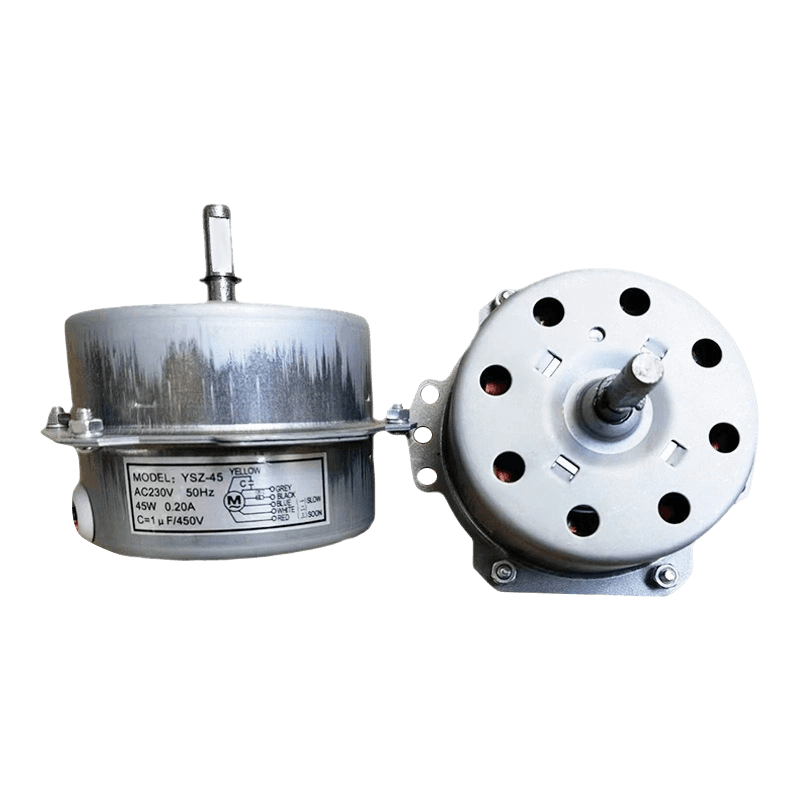
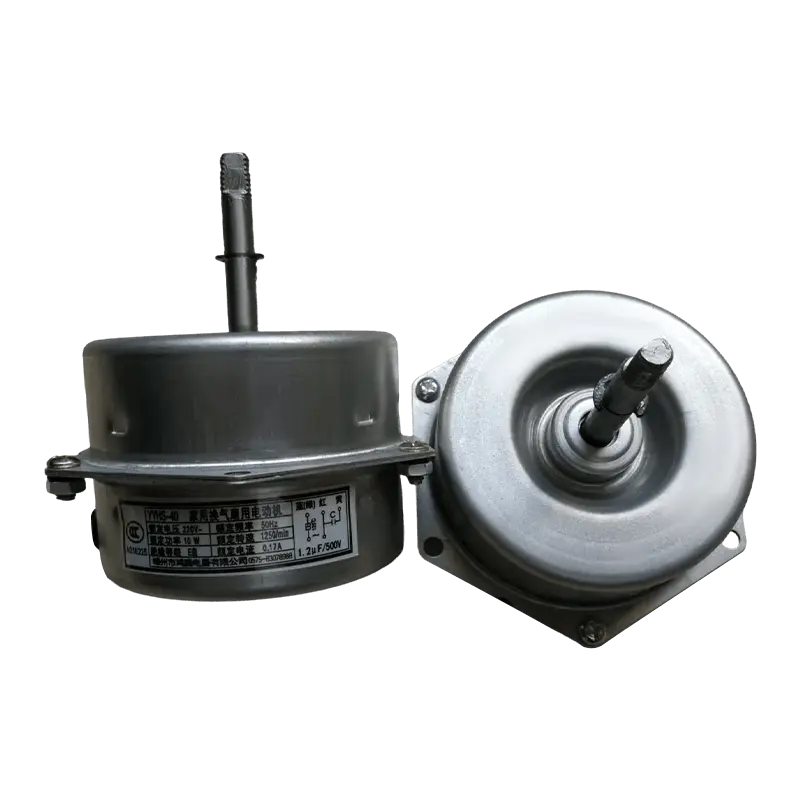
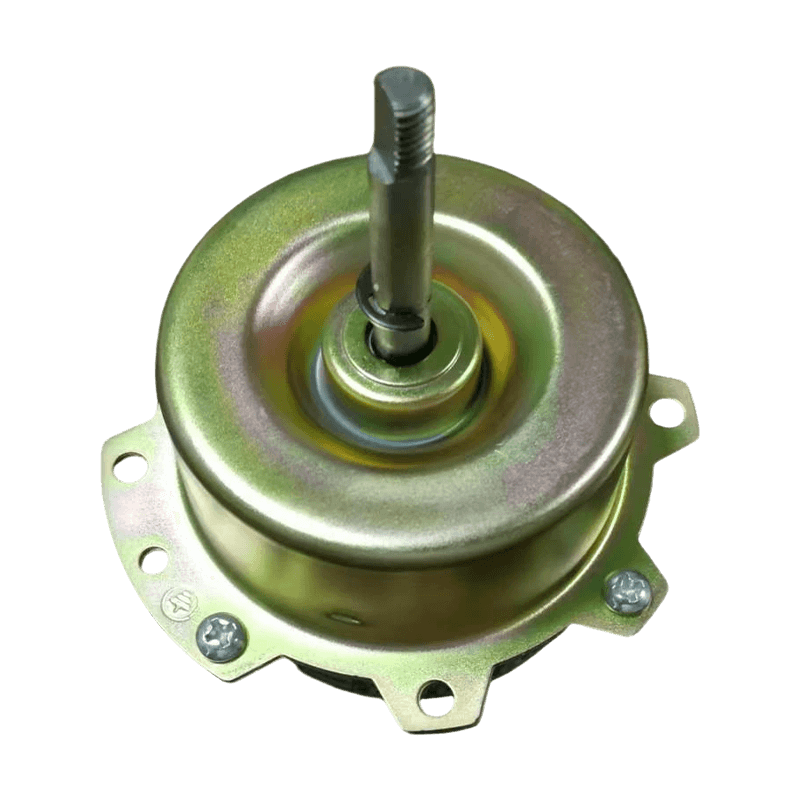 YYHS-30 Integrated Ceiling Ventilator Motor with Bidirectional RotationA low-noise bidirectional ball motor for integrated ceiling ventilators and exhaust fans, offering stable operation and durable construction for household ventilation systems.View Product →
Kitchen range hoods are another familiar home. The blower there has to overcome a grease filter and several meters of ductwork, which is why hood motors are usually the most powerful motor in the house after the compressor. Air purifiers use blowers too, since a filter media is a serious obstruction. Hand dryers, vacuum cleaners, and clothes dryers round out the list, each one asking the same question of its motor: can you keep turning while the air around you is loaded with dust or moisture?
Choosing a motor is less about raw power and more about fit. A few points we usually raise with customers at the drawing stage:
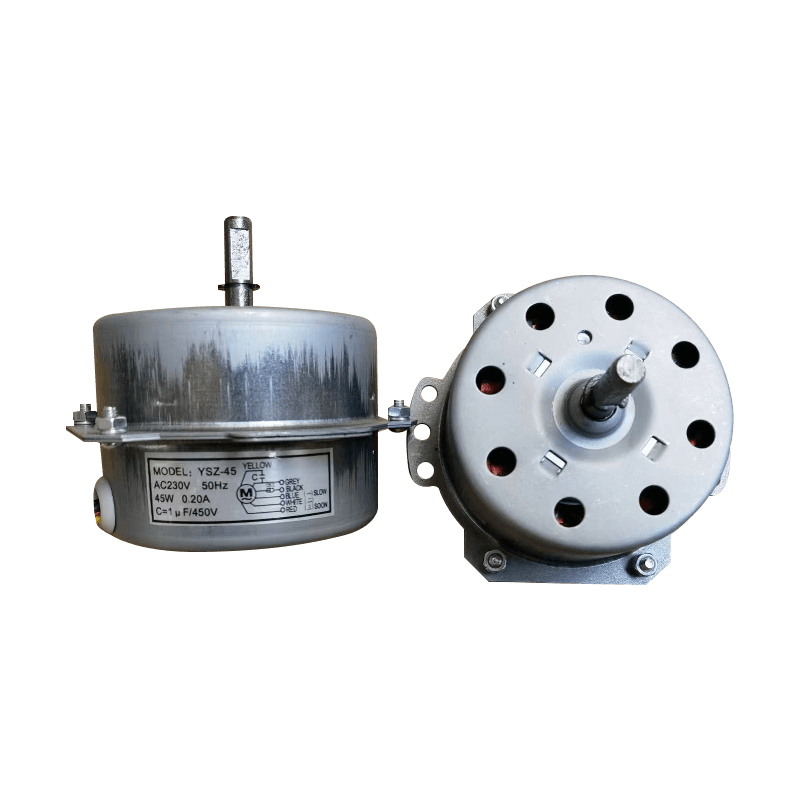 Air Purifier Motor with Intelligent Temperature ControlA low-noise, energy-saving motor for air purifiers, with intelligent temperature control for continuous operation in homes, offices, and hospitals.View Product →
 Quick-Drying Hand Dryer Motor for Commercial and Public RestroomsA high-efficiency, low-noise hand dryer motor with waterproof and dustproof design for humid, high-traffic public restrooms, hospitals, restaurants, and airports.View Product →
If you are still sorting out which motor family suits your product, our guide to home appliance AC motors walks through the main types and their applications in more detail.
Most complaints about blowers come down to a handful of causes, and they are usually not the motor itself:
Largely, yes. The two terms describe the same principle, with "blower" generally used when the device must develop meaningful static pressure. A centrifugal fan with a scroll housing is what most people mean by a blower.
Without a housing, the wheel still moves air, but the pressure advantage disappears. The scroll collects the discharged air and guides it to one outlet, which is what makes the design useful against filters and ducts.
Yes. Three-speed tap windings are the common household solution, giving low, medium, and high settings from a single motor without any electronics.
Sound depends on wheel balance, bearing quality, inlet shape, and the obstacle the air must pass. A well-matched motor and wheel in a clean assembly is typically quiet enough to disappear into the background of a home.
We design and build small AC motors for exhaust fans, ventilators, air purifiers, hand dryers, fans of every kind, and washing machines, all from our own factory in Shengzhou. If you are working on a blower application and need a motor that fits your airflow curve, your voltage, and your mounting space, take a look at our motor range or send us your requirements. We are always glad to talk through the details before a drawing is finalized.
Recommended Products

Contact Us
+86 0575 83078988
+86 13605855838
+86 17769850789
13605855838
No. 20, Zhiye Road, Changle Town, Shengzhou City, Shaoxing City, Zhejiang Province
Contact Us
 Custom Mini AC Motor Manufacturers