English
 中文简体
中文简体

Quick Product Search
Contact us to learn how we can use our expertise to bring you high-quality products.
2026-08-27
When a floor fan stops rotating, the most common cause sits right inside the motor housing. The fan blades may still be loose, the capacitor may fail, or the bearing may be seized, but none of those parts can be solved by replacing the entire fan. One maintenance manager told us that a batch of fans failed after only three months because the armature shaft was not properly hardened, so the bearing race simply wore out. For appliance manufacturers and maintenance teams, choosing the right floor fan motor is a decision that directly determines service life, noise level, and warranty returns. In this article, we explain the key specifications to compare, the failures to anticipate, and the sourcing choices that make a motor easier to integrate and longer lasting.
Before you compare motor models, you need to define the operating envelope. The fan's blade diameter, the required airflow, and the electrical voltage in your target market all narrow the motor options. The table below shows the typical parameters that appear in floor fan motor datasheets and what each one means for your product.
| Parameter | What It Affects | Common Range |
|---|---|---|
| Voltage / Frequency | Compatibility with national grid standards | 110-120 V, 220-240 V, 50/60 Hz |
| Rated Power | Airflow capacity and energy consumption | 20 W to 80 W |
| Speed | Air movement comfort and noise | 1200 RPM to 1500 RPM |
| Bearing Type | Noise level and service life | Sleeve, ball, or self-lubricating |
| Mounting Dimensions | Fit with fan housing and brackets | Shaft diameter, housing diameter, bolt holes |
| Thermal Protection | Ability to withstand overloads | Fuse, thermal cutoff, or PTC |
Voltage and frequency are usually fixed by the end market. A 60 Hz motor sold into a 50 Hz market will run slower, overheat, and lose torque unless the winding is designed for both. Power rating tells you roughly how much air the fan can move, but blade shape and pitch also matter. Speed is often controlled by a three-speed switch on the fan body, so the motor must tolerate repeated low-voltage starts without burning the winding. Bearing type matters for noise: ball bearings start with low friction, while sleeve bearings may squeal after months of use. Mounting dimensions are important for OEM integration because motor substitution often requires new tooling or bracket changes. Finally, thermal protection is a simple but effective way to avoid smoke and warranty claims when a fan is blocked or the capacitor fails.
Beyond the basic datasheet, some motor suppliers also provide a performance curve that shows torque at different speed points. This is useful when you want to know whether the motor can start the fan at low voltage. In practice, the starting torque is the first value to check. A floor fan with a small blade may start easily at 90% rated voltage, but a larger blade could need 30% more starting torque. If the motor does not reach rated speed within a second, the winding will overheat.
The most frequently reported floor fan motor failures are not manufacturing defects, they are application failures. Understanding them helps you avoid returns and improves customer satisfaction.
These failures show that motor selection is not just about price. A slightly more expensive motor with ball bearings and a proper thermal fuse can save thousands of dollars in field service costs.
When you receive sample motors, run a locked-rotor test and a high-temperature aging test. A locked-rotor test tells you whether the thermal protector trips before the winding reaches a dangerous temperature. A high-temperature aging test simulates years of operation in a hot room and helps you verify if the bearing grease survives. These tests are more reliable than visual inspection alone.
A floor fan is a simple appliance, but its motor has to work with a specific blade design and a specific electrical system. There are two common AC motor topologies.
Shaded pole motors have no capacitor and no centrifugal switch. They are compact, inexpensive, and reliable for small fans. They do have a lower efficiency than capacitor motors, but for a standard 16-inch floor fan, the difference is acceptable. When you need a low-noise, three-speed floor fan motor, our YJF25 three-speed adjustable low-noise shaded pole motor is designed for that duty.
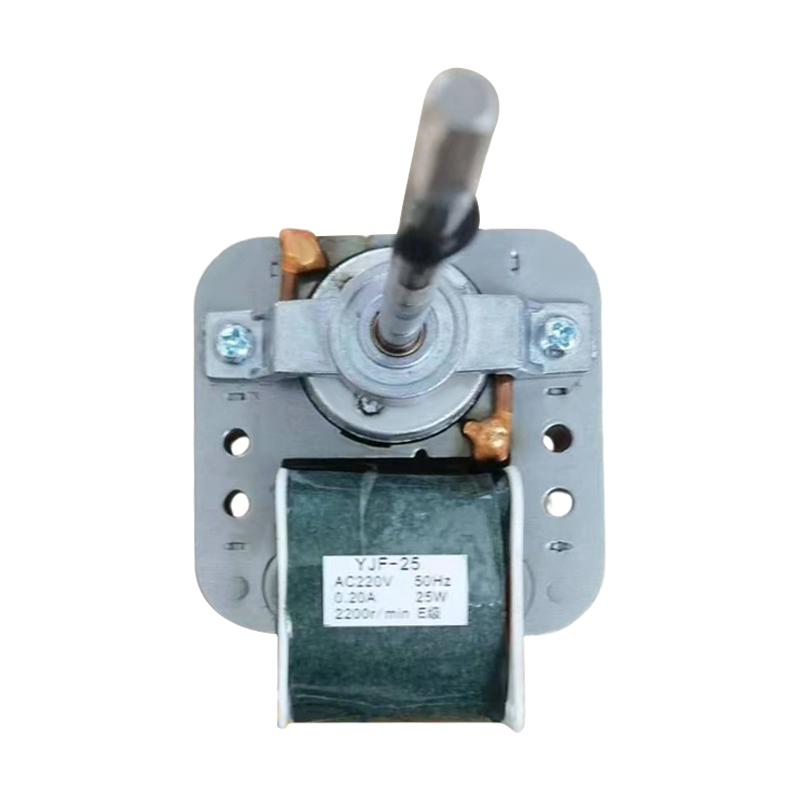 Three-Speed Low-Noise Shaded Pole Motor for Floor FansThis motor is ideal for small fans needing quiet, stable airflow. Its three-speed control fits varied needs, while the shaded pole design ensures reliability and low hum, making it suitable for home use with minimal noise.View Product →
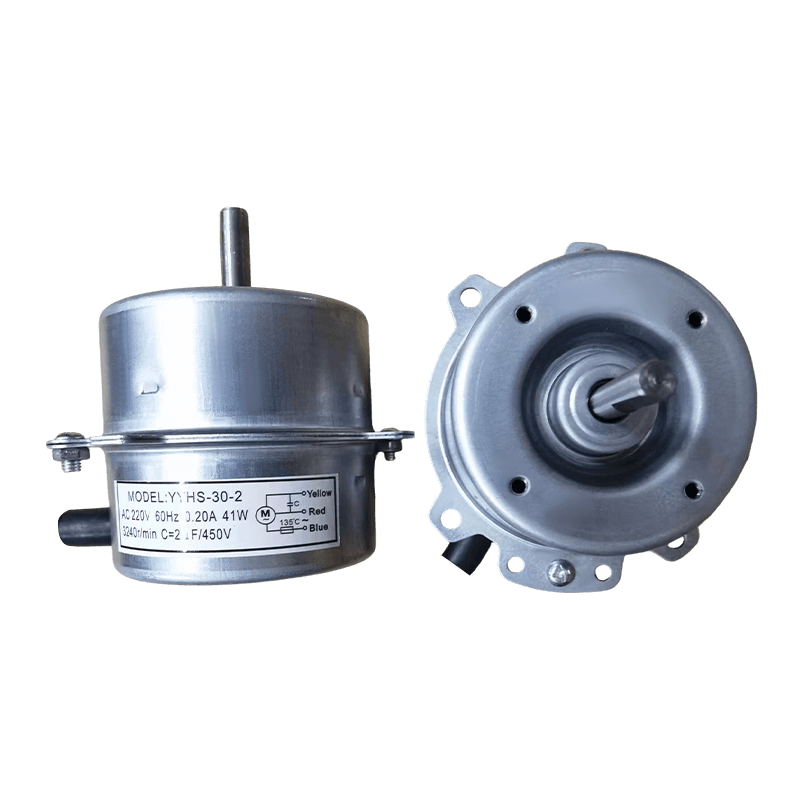
For larger blades or more demanding airflow requirements, a capacitor-run motor provides higher starting torque and better efficiency. It uses an electrolytic or film capacitor to create a rotating magnetic field. This type is common in premium floor fans and air-conditioning fans. Our YSZ60 three-speed air-conditioning fan motor is one of these products, and it appears in our floor fan motor category because it can power larger fan blades at lower noise levels.
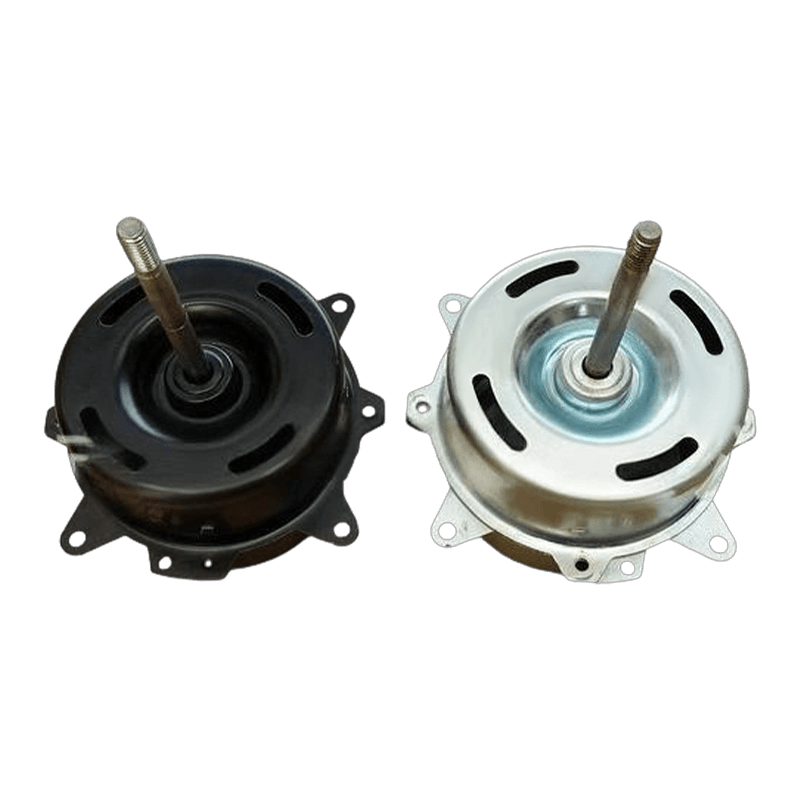 Three-Speed Capacitor-Run Motor for Air Conditioning FansThis capacitor-run motor offers high starting torque and efficiency, ideal for larger blades. It runs quietly and supports three speeds, making it a robust choice for air conditioners and floor fans.View Product →
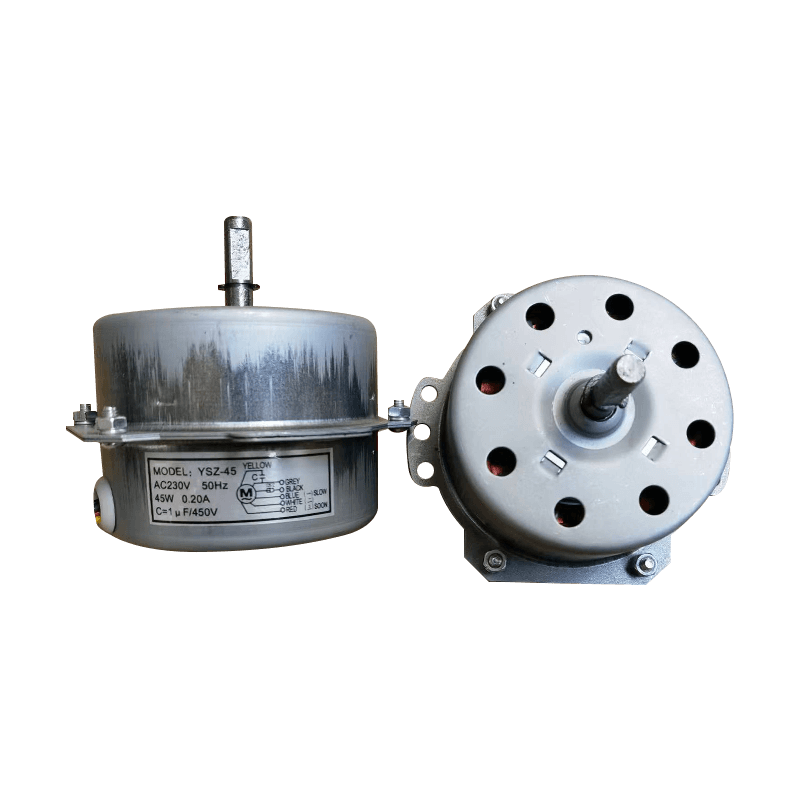
The winding material and bearing solution have a direct effect on how long the motor stays quiet and cool. Full copper windings have lower resistance than aluminum, which means less heat and longer insulation life. For the tower and compact fan applications, our YSZ45 three-speed adjustable fan motor for home cooling is a good example of a compact solution with a copper winding. For floor fans, the same attention to copper material can prevent premature winding failures.
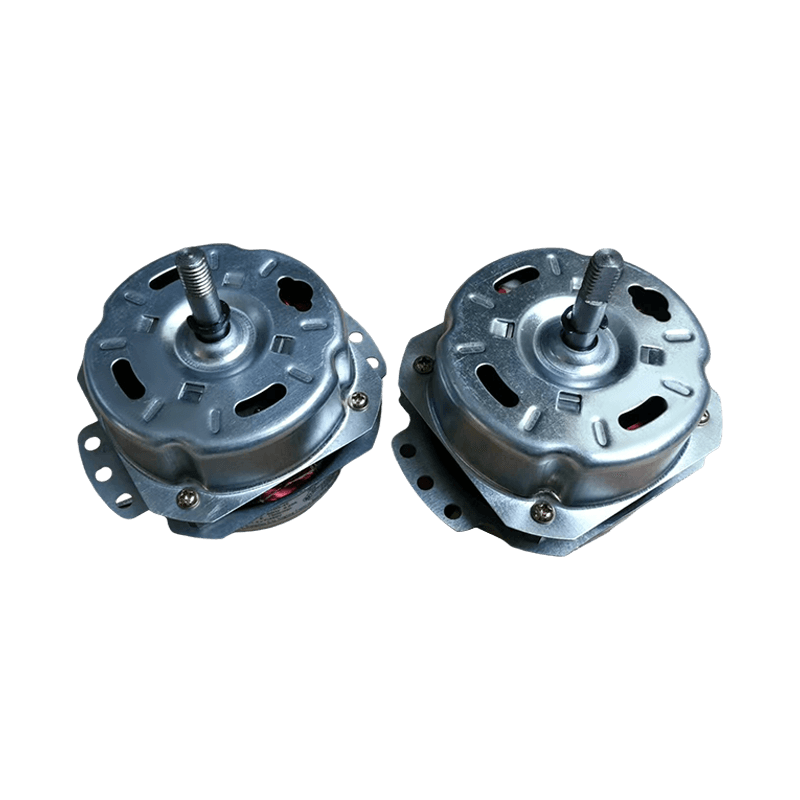 Three-Speed Compact Copper-Winding Fan MotorFeaturing full copper windings, this motor reduces heat and extends insulation life, ensuring durable performance in oscillating fans. Its compact design and three-speed settings make it a versatile OEM option.View Product →
When you are sourcing a floor fan motor for OEM production, you need a supplier that can adapt to your market. This includes voltage and frequency, safety certifications, and delivery terms. Some motors are restricted to a single market because of their winding and thermal protection design. Others can be customized quickly. Since we are a manufacturer with our own factory, we can produce motors with different voltages and frequencies to match your target countries. This shortens development time and helps you avoid electrical compatibility issues.
For exports to the United States, UL or ETL certification is often required. For Europe, CE marking is minimum but a safety appraisal is expected. Your motor supplier should provide the correct certifications for your target markets. If not, you may need to run additional tests that delay production.
To dive deeper into how floor fan AC motors work and what you should check during the sample evaluation, read our guide Understanding Floor Fan AC Motors.
Choosing a floor fan motor is not a one-size-fits-all decision. You need to balance airflow, efficiency, noise, and reliability. Start with the table we provided, compare the failure modes against your product environment, then shortlist a motor that fits your mechanical and electrical requirements. If you have a specific fan design and need a compatible motor, our engineering team can help you select the right model.
Recommended Products

Contact Us
+86 0575 83078988
+86 13605855838
+86 17769850789
13605855838
No. 20, Zhiye Road, Changle Town, Shengzhou City, Shaoxing City, Zhejiang Province
Contact Us
 Custom Mini AC Motor Manufacturers